About
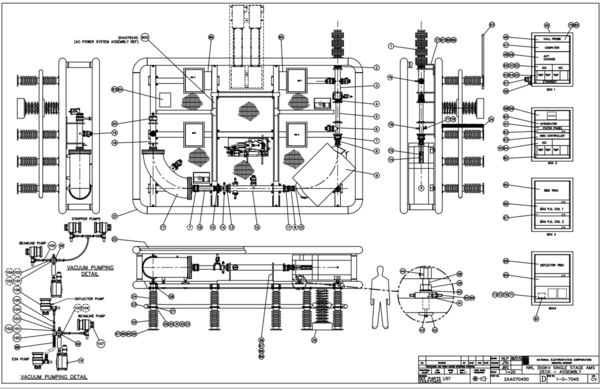
Unlike other spectrometers, NAUTILUS combines two separate processes for materials analysis. It uses secondary ion mass spectrometry (SIMS) analysis along with single-stage accelerator mass spectrometry (SSAMS). The addition of SSAMS makes NAUTILUS over 10 times more sensitive than commercial SIMS instruments.
Secondary Ion Mass Spectrometry (SIMS)
Secondary ion mass spectrometry (SIMS) is a sophisticated analytical technique used primarily for the detailed analysis of solid surfaces and thin films. This method involves bombarding a material's surface with a focused beam of primary ions, which leads to the ejection of secondary ions from the surface. The mass-to-charge ratios of these secondary ions are then measured using a mass spectrometer to determine the elemental, isotopic, or molecular composition of the surface to a depth of approximately one to two nanometers. SIMS cannot, however, differentiate molecule from isotopes of the same mass.
Single-stage Accelerator Mass Spectrometry (SSAMS)
SSAMS refers to "Single Stage Accelerator Mass Spectrometry," which is a high-precision measurement technique utilizing accelerator mass spectrometry (AMS) technology. Accelerator mass spectrometry (AMS) is a highly sensitive analytical technique used primarily for measuring isotopes, particularly carbon-14, in various samples. This method allows for the detection and quantification of rare isotopes by accelerating ions to high energies and analyzing their mass-to-charge ratios.
The strengths of an SSAMS system are that it is the smallest and least expensive system capable of AMS analysis. Since it can be operated with the injection of either positive or negative ions, it can be used with an appropriate ion source that is optimal for the isotope of interest. This makes it quite versatile. For example, 14C benefits from a negative ion formation to suppress the 14N contaminant while actinides produce higher positive ion intensities (as well as noble gases which can only be produced with a positive ion source). When compared to other mass spectrometry techniques, these systems can reduce molecular interference with the use of higher energy acceleration combined with gas stripping. The success of these compact systems for AMS applications can be seen through research from ETH in Zurich.
By combining both techniques, The Naval Ultra-Trace Isotope Laboratory's Universal Spectrometer, known as NAUTILUS, combines secondary ion mass spectrometry (SIMS) and single-stage accelerator mass spectrometry (SSAMS) for spatially resolved trace element and isotope analysis. NAUTILUS provides a unique analysis, and is designed to perform high-resolution analyses of various materials, allowing for precise measurements of trace elements and isotopes. The combination of SIMS and SSAMS enhances the instrument's capability by leveraging the strengths of both techniques while mitigating their individual drawbacks.
Key Features
-
Molecule-filtering detector: The instrument includes an additional detector to filter out molecules, which significantly improves analytical performance.
-
Sensitivity: NAUTILUS boasts a sensitivity to trace elements that is at least ten times better than traditional commercial SIMS instruments, attributed to its near-zero background conditions.
-
Raster ion imaging: This technique enables direct spatially resolved analysis of heterogeneous materials, which can have perturbed isotopic compositions or not
Applications
The NAUTILUS spectrometer has wide applications in:
-
Nuclear materials analysis: Supporting research in nuclear science and technology.
-
Cosmochemistry: Providing insights into the chemical composition and processes of celestial bodies.
-
Geochemistry: Facilitating the understanding of the chemical characteristics of Earth materials and geological processes.
Overall, NAUTILUS serves as a crucial tool for researchers, enhancing the accuracy and scope of trace isotope analysis across various scientific fields.