<?xml version="1.0" encoding="UTF-8"?>
<?xml-stylesheet type="text/xsl" href="/stylesheets/feed.atom.xml" media="screen"?>
<feed xml:lang="en-US" xmlns="http://www.w3.org/2005/Atom">
  <id>tag:nautilus.nd.edu,2005:/news</id>
  <link rel="alternate" type="text/html" href="https://nautilus.nd.edu"/>
  <link rel="self" type="application/atom+xml" href="https://nautilus.nd.edu/news.atom"/>
  <id>tag:nautilus.nd.edu,2005:/latest</id>
  <title>NAUTILUS | News</title>
  <updated>2024-08-08T16:14:00-04:00</updated>
  <link rel="alternate" type="text/html" href="https://nautilus.nd.edu/"/>
  <link rel="self" type="application/atom+xml" href="https://nautilus.nd.edu//news.atom"/>
  <subtitle>Discover how NAUTILUS, a one-of-a-kind system for materials analysis, is advancing research and collaboration.</subtitle>
  <entry>
    <id>tag:nautilus.nd.edu,2005:News/167907</id>
    <published>2024-08-08T16:14:00-04:00</published>
    <updated>2024-11-06T10:18:55-05:00</updated>
    <link rel="alternate" type="text/html" href="https://nautilus.nd.edu/news/universities-are-critical-to-national-security-argues-notre-dame-vice-president-for-research-jeff-rhoads/"/>
    <title>Universities are critical to national security, argues Notre Dame vice president for research Jeff Rhoads</title>
    <summary type="text">
      <![CDATA[University of Notre Dame vice president for research Jeffrey F. Rhoads contributed to a panel discussion on university-industry partnerships, arguing that universities play a critical role in ensuring national security and global competitiveness.…]]>
    </summary>
    <content type="html">
      <![CDATA[<p>University of Notre Dame vice president for research <a href="https://research.nd.edu/people/jeffrey-rhoads/">Jeffrey F. Rhoads</a> contributed to a panel discussion on university-industry partnerships, arguing that universities play a critical role in ensuring national security and global competitiveness.</p>
<p>The panel took place on August 7, 2024, in Washington, DC, as part of the second annual meeting of the Emerging Technologies Institute conference. The event brought together technology leaders in government, the defense industry, the commercial sector, and academia to discuss national security and innovation needs.</p>
<p>Rhoads, also a professor in Notre Dame’s <a href="https://ame.nd.edu/">Department of Aerospace and Mechanical Engineering</a>, was joined on stage by Rodney Bowersox, senior associate dean for research at Texas A&amp;M University’s College of Engineering; Mark Lewis, president of the Purdue Applied Research Institute; and Theresa Mayer, vice president for research at Carnegie Mellon University. Bindu Nair, director of Basic Research in the Office of the Under Secretary of Defense for Research and Engineering, served as the moderator for the panel.</p>
<p>Rhoads highlighted the need for universities to foster innovations that can ensure national security in a time of rapid technological change, saying, “To face the challenges of tomorrow, we need all hands—industry, academia, and government—on deck.”</p>
<p>Rhoads explained that Notre Dame’s commitment to national security has a long history. “We are a University where ‘God, Country, Notre Dame’ is literally etched in stone above the door of our Basilica. Service to our country is part of our mission,” Rhoads said. “That gives us a mandate to think carefully about peacemaking and the right way to support the national security innovation ecosystem.”</p>
<p>Rhoads’s main message to his audience of Department of Defense and national security professionals was to rethink the way they partner with academic institutions.</p>
<p>“Many of our nation's competitors around the world may not have market economies or the democratic freedoms that we have; in many cases, the governments may be fully integrated with academia,” Rhoads explained. “It’s essential that we also have vertical integration—but in a way that aligns with our nation’s democratic values and respects our freedoms.” We can do that, Rhoads said, through “true partnerships, where university researchers learn from industry in order to ensure the research that happens on campus translates into the real world.”</p>
<p>Rhoads encouraged industry professionals who have not partnered with university researchers before to consider a shared research project.</p>
<p>“We are not the universities of ten years ago,” Rhoads said, “If you haven’t had a chance to partner with a university, I think you’ll be amazed at the value a university can bring to the innovation ecosystem.”</p>
<p>To learn more about Notre Dame’s mission as a leading research institution, watch an <a href="https://stories.nd.edu/podcasts/notre-dame-as-a-leading-research-university/">interview with Vice President for Research Jeff Rhoads</a>, or <a href="mailto:research@nd.edu">send an email to Notre Dame Research</a>. To sign up to receive news and updates about research at Notre Dame, please <a href="https://research.nd.edu/news-and-events/newsletter/subscribe/">subscribe to our newsletter</a>.</p>
<p><em><strong>Contact:</strong> Brett Beasley / Writer and Editorial Program Manager</em></p>
<p><em>Notre Dame Research / University of Notre Dame</em></p>
<p><em>bbeasle1@nd.edu / +1 574-631-8183</em></p>
<p><em>research.nd.edu / @UNDResearch</em></p>
<p><strong><em>About Notre Dame Research:</em></strong></p>
<p><em>The University of Notre Dame is a private research and teaching university inspired by its Catholic mission. Located in South Bend, Indiana, its researchers are advancing human understanding through research, scholarship, education, and creative endeavor in order to be a repository for knowledge and a powerful means for doing good in the world. For more information, please <a href="https://research.nd.edu/">visit the Notre Dame Research website</a>.</em></p>]]>
    </content>
    <link rel="enclosure" type="image/jpeg" href="https://nautilus.nd.edu/assets/592726/eti.jpg" title="A man in a dark pink blazer speaks into the microphone while sitting behind a blue table with four other panelists."/>
    <author>
      <name>Brett Beasley</name>
    </author>
  </entry>
  <entry>
    <id>tag:nautilus.nd.edu,2005:News/167863</id>
    <published>2023-08-18T16:58:00-04:00</published>
    <updated>2024-10-30T16:14:36-04:00</updated>
    <link rel="alternate" type="text/html" href="https://nautilus.nd.edu/news/notre-dame-receives-nautilus-a-one-of-a-kind-system-for-materials-analysis-from-us-navy/"/>
    <title>Notre Dame receives NAUTILUS, a one-of-a-kind system for materials analysis, from US Navy</title>
    <summary type="text">
      <![CDATA[The United States Navy has transferred NAUTILUS, a one-of-a-kind system for materials analysis, to the University of Notre Dame.]]>
    </summary>
    <content type="html">
      <![CDATA[<figure class="image-default"><img src="https://news.nd.edu/assets/527665/fullsize/nrl_signing_1000.jpg" alt="Nrl Signing 1000" width="1000" height="563">
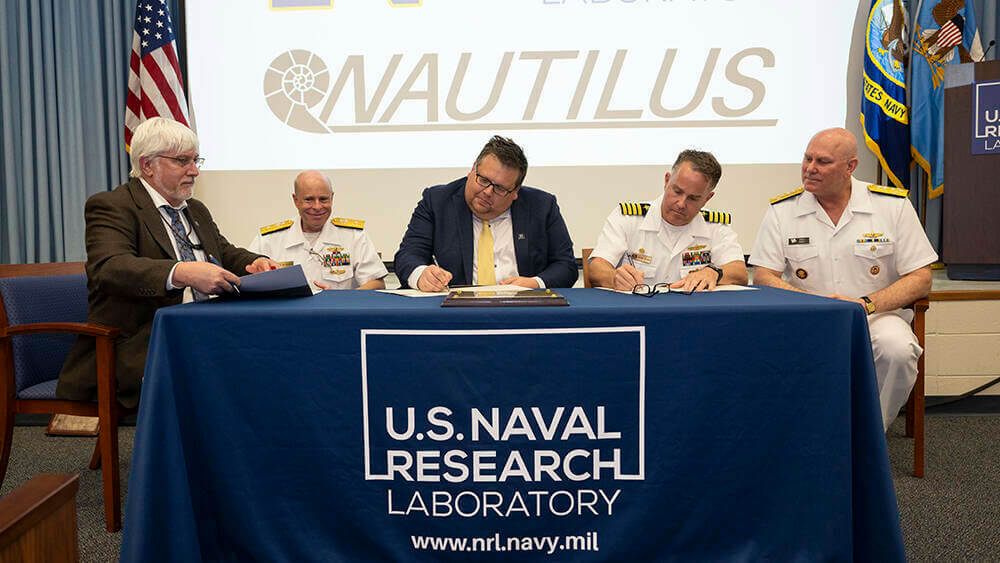
<figcaption>Bruce Danly (left), U.S. Naval Research Laboratory director of research, Capt. Jesse Black (center-right), NRL commanding officer, and Jeff Rhoads (center), Notre Dame vice president for research, sign an Education Partnership Agreement transferring NRL’s NAUTILUS instrument to Notre Dame during an event in Washington, D.C.  The NAUTILUS provides measurement capabilities for research in atomic mass spectrometry. (U.S. Navy photo by Sarah Peterson)</figcaption>
</figure>
<p> </p>
<p>The United States Navy has transferred <a href="https://pubs.rsc.org/en/content/articlelanding/2020/ja/c9ja00344d">NAUTILUS</a>, a one-of-a-kind system for materials analysis, to the University of Notre Dame. The transfer occurred during a ceremony held at the Naval Research Laboratory in Washington, D.C.</p>
<p><a href="https://research.nd.edu/people/jeffrey-rhoads/">Jeffrey F. Rhoads</a>, vice president for research and professor in the <a href="https://ame.nd.edu/">Department of Aerospace and Mechanical Engineering</a>, said, “We are so grateful for our long-standing relationship with the United States Navy. For over 80 years, we have worked together with a shared mission to serve our country and its people, and today is just another example of Notre Dame and the Navy working together to drive innovation for the betterment of the United States.”</p>
<p>Rhoads added that “the transfer of NAUTILUS to our campus in South Bend is not only a generous gift, but it will be an impactful one. At Notre Dame, our researchers will steward it well, using it to explore and discover new knowledge as they advance their research and lean into our research ethos of doing good in the world.”</p>
<p>The name NAUTILUS stands for NAval Ultra-Trace Isotope Laboratory Universal Spectrometer. Unlike other spectrometers, NAUTILUS combines two separate processes for materials analysis. It uses secondary ion mass spectrometry (SIMS) analysis along with single-stage accelerator mass spectrometry (SSAMS). The addition of SSAMS makes NAUTILUS over 10 times more sensitive than commercial SIMS instruments.</p>
<p><a href="https://physics.nd.edu/people/philippe-collon/">Philippe Collon</a>, professor and associate chair in the <a href="https://physics.nd.edu/">Department of Physics and Astronomy</a>, explained, “NAUTILUS excels at detecting impurities in a material. It enables what you might call ‘needle in a haystack’ work. But instead of a needle in a haystack, imagine detecting a single bottle of pollutants poured into Lake Michigan — then you have an idea of the kind of extremely precise analysis this instrument is capable of.”</p>
<p>NAUTILUS’ unique capabilities will augment the University’s existing research expertise. As part of one of the world’s longest-running particle accelerator research programs, Notre Dame currently operates several low-energy accelerators.</p>
<figure class="image-right"><img src="https://news.nd.edu/assets/527664/366x300/nrl_group_shot_366.jpg" alt="Nrl Group Shot 366" width="366" height="300">
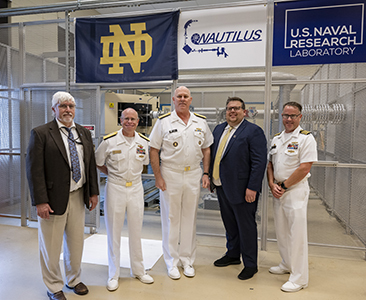
<figcaption>Capt. Jesse Black (right), U.S. Naval Research Laboratory commanding officer, Bruce Danly (left), NRL director of research, Chief of Naval Research Rear Adm. Kurt Rothenhaus (center-left), Vice Chairman, Joint Chiefs of Staff Adm. Christopher W. Grady (center), and Jeff Rhoads (center-right),  University of Notre Dame vice president for research,  during an event to transfer NRL’s NAUTILUS instrument to Notre Dame in Washington, D.C. on Aug. 18. The NAUTILUS measures nuclear, cosmo/geo-chemical and electronic materials. (U.S. Navy photo by Sarah Peterson)</figcaption>
</figure>
<p>By transferring NAUTILUS from the Naval Research Laboratory in Washington, D.C., to South Bend, the U.S. Navy will foster collaborative research with Notre Dame faculty members while also making new connections with other universities and national laboratories that will be able to now use NAUTILUS at the University.</p>
<p>“This transfer, authorized by Congress and facilitated through educational partnership agreements, is more than a mere exchange of equipment,” said Adm. Christopher Grady, vice chairman of the Joint Chiefs of Staff and a 1984 Notre Dame graduate. “It is a commitment to fostering further innovation and research that can be applied to Naval and national security challenges, enhancing collaboration between government and academia and strengthening America’s competitive advantage in the global scientific arena.”</p>
<p>Notre Dame researchers said they plan to integrate NAUTILUS into several existing research projects.</p>
<p>For example, <a href="https://physics.nd.edu/people/philippe-collon/">Collon</a> will use NAUTILUS to understand the processes that formed our solar system, while <a href="https://engineering.nd.edu/faculty/clive-neal/">Clive Neal, a professor</a> in the <a href="https://ceees.nd.edu/">Department of Civil and Environmental Engineering and Earth Sciences</a>, will use NAUTILUS to bring a new dimension to his lunar samples. <a href="https://engineering.nd.edu/faculty/amy-e-hixon/">Amy Hixon</a> and <a href="https://engineering.nd.edu/faculty/antonio-simonetti/">Antonio Simonetti</a>, both associate professors in the <a href="https://ceees.nd.edu/">Department of Civil and Environmental Engineering and Earth Sciences</a>, will use NAUTILUS to test samples from the Ewing Mineral Collection at Notre Dame.</p>
<p>Once NAUTILUS is operational in its new home on Notre Dame’s main campus, it will be the center of a new University-wide research facility managed by the <a href="https://science.nd.edu/">College of Science</a>, the <a href="https://engineering.nd.edu/">College of Engineering</a> and <a href="https://research.nd.edu/">Notre Dame Research</a>. Researchers from the <a href="https://isnap.nd.edu/about/">Institute for Structure and Nuclear Astrophysics (ISNAP)</a> and <a href="https://energy.nd.edu/">ND Energy</a> will serve as frequent collaborators, and NAUTILUS will also be available to research groups from outside the University.</p>
<p>According to Collon, some of the biggest benefits of NAUTILUS’ presence at Notre Dame will be for students.</p>
<p>“The next generation of STEM researchers are going to be tasked with doing a more careful analysis of material with smaller and smaller samples to detect things like very advanced forgeries, for example. Students who work with NAUTILUS can learn a comprehensive set of techniques — how to understand ion optics, how to run an accelerator, how to analyze its data and how to optimize tests. That is training we will now be able to offer to our undergraduate and graduate students using this one very advanced piece of equipment.”</p>
<p>To learn more about nuclear science at Notre Dame, visit <a href="https://isnap.nd.edu/">isnap.nd.edu</a>.</p>
<p> </p>
<p class="attribution">Originally published by <span class="rel-author">Brett Beasley</span> at <span class="rel-source"><a href="https://news.nd.edu/news/notre-dame-receives-nautilus-a-one-of-a-kind-system-for-materials-analysis-from-us-navy/">news.nd.edu</a></span> on <span class="rel-pubdate">August 18, 2023</span>.</p>]]>
    </content>
    <link rel="enclosure" type="image/jpeg" href="https://nautilus.nd.edu/assets/592517/nrl_signing_1000.jpg" title="A man in a dark blue suit and yellow tie sits behind a blue table and signs a piece of paper, surrounded by men in white U.S. Navy uniforms."/>
    <author>
      <name>Brett Beasley</name>
    </author>
  </entry>
</feed>